
AAMA
Armasuisse
BMW
Daimler Buses
German railway
Liebherr
Mercedes/Daimler
NATO
Porsche
Other
Volkswagen
Corrosion is a widespread problem that affects materials and structures. It can lead to significant damage, financial losses and safety risks. In sectors such as the automotive, transport, aviation, construction and maritime industries in particular, effective corrosion protection is of great importance in ensuring the durability and reliability of materials and products.
In order to assess corrosion resistance and facilitate the selection of suitable corrosion protection measures, the salt spray test – also known as the salt spray test or salt mist test – was developed in accordance with DIN EN ISO 9227. This standard defines the test conditions for the best-known test method in the field of corrosion protection.
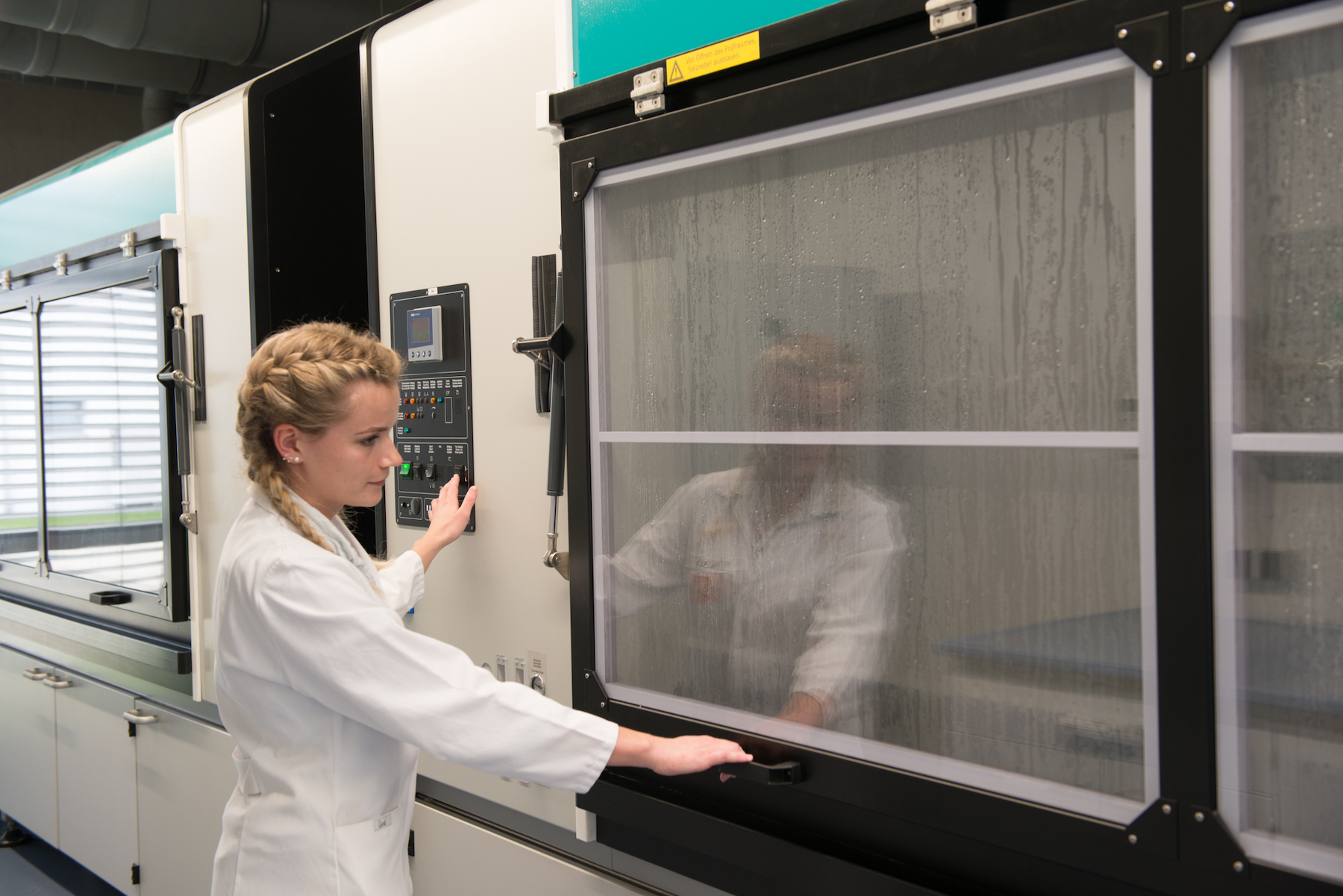
With our state-of-the-art salt spray chambers, we offer you a fast and reliable testing service for your components in accordance with DIN EN ISO 9227 and ASTM B117. Our chambers also allow for the testing of large-format samples up to 2 m in length. In addition, we carry out cyclic corrosion tests in accordance with current standards, including those from the automotive industry such as VDA 621-415, PV 1209 and PV 1210, which include the salt spray test or salt spray chamber test.
The main objective of DIN EN ISO 9227 is to establish standardised test methods for corrosion protection. By defining objective test procedures, the standard ensures that results can be compared. It specifies the conditions under which materials are to be tested in order to determine their suitability for various environments.
It is important to note, however, that the results obtained in the test procedures set out in DIN EN ISO 9227 cannot be directly applied to the actual resistance of materials in real-world conditions. Corrosion protection testing in controlled laboratory environments is designed to assess relative corrosion behaviour and to test materials under accelerated conditions. Actual conditions can vary considerably, including the composition of the environment, temperature, humidity and other factors that may influence corrosion.
DIN EN ISO 9227 does not specify the requirements that components must meet. This applies both to the duration of the test and to the evaluation procedures carried out following the test.
DIN EN ISO 9227 defines three different test methods for corrosion protection testing: the neutral salt spray test (NSS test), the copper-accelerated acetic acid salt spray test (CASS test) and the acidic salt spray test (AASS test).
NSS
The salt spray test (NSS test) is the best-known test method and is used to assess the corrosion resistance of materials. In this test, a pH-neutral saline mist is generated and applied to the materials under test. The presence of chlorides significantly accelerates corrosion, and ordinary steel corrodes within a very short time.
AASS
The acidic salt spray test (AASS test) is a further development of the NSS test. In this test, an acidic component – usually acetic acid – is added to the salt spray to make the corrosion conditions more severe. This method is used in particular to accelerate the corrosion of aluminium and aluminium alloy surfaces. These would need to be tested for significantly longer in the neutral salt spray test in order to obtain relevant results. The additional acceleration enables time-saving and cost-effective testing of aluminium and aluminium alloy surfaces compared with the neutral salt spray test.
CASS
The copper-accelerated salt spray test (CASS test) is another test method in accordance with DIN EN ISO 9227. In the CASS test, copper salts are added to the test solution to accelerate corrosion even further. This corrosion test enables a faster assessment of the corrosion resistance of materials and is frequently used in the automotive and aerospace industries.
The acidic salt spray test (AASS test) is a further development of the NSS test. In this test, an acidic component – usually acetic acid – is added to the salt spray to make the corrosion conditions more severe. This method is used in particular to accelerate the corrosion of aluminium and aluminium alloy surfaces. These would need to be tested for significantly longer in the neutral salt spray test in order to obtain relevant results. The additional acceleration enables time-saving and cost-effective testing of aluminium and aluminium alloy surfaces compared with the neutral salt spray test.
Once the salt spray test has been completed, the components subjected to the test are assessed. Although DIN EN ISO 9227 does not set out any specific requirements in this regard, it refers to possible methods that may be usefully applied. The most common of these include:
01
This involves checking whether any signs of corrosion are visible on the component. This is particularly applicable to electroplated components.
02
The ISO 4628 series of standards enables the visual assessment of coated surfaces following a salt spray test. These evaluation methods are frequently used on painted components and quantify, for example, blistering, rust formation or delamination at the scratch.
03
ISO 2409 defines the cross-hatch test as a method for assessing the adhesion of a coating to a substrate following exposure to salt spray.
01
Please describe your component and the relevant standard – using the form, in any format. You may also attach supporting documents such as drawings or specifications.
02
Together, we determine the test method (NSS, CASS or AASS), the test duration and the evaluation method – the standard itself does not specify either of these.
03
Your test samples undergo NSS, AASS or CASS testing in our chambers – with test parameters monitored on a daily basis.
04
We evaluate the components under load in accordance with the agreed procedure and document the test conditions and results in the test report.
The salt spray test – also known as a salt spray test or salt mist test – is the best-known accelerated testing method in the field of corrosion protection. Test specimens are exposed to a defined salt mist within a chamber. The standard specifies the test conditions for this, thereby ensuring comparable results.
The NSS test uses a neutral sodium chloride solution. In the AASS test, the same solution is acidified with acetic acid. The CASS test also contains copper(II) chloride and is carried out at an elevated temperature – it accelerates corrosion to the greatest extent. The AASS and CASS tests are primarily used for decorative coatings and anodised aluminium.
DIN EN ISO 9227 does not specify a test duration – this is determined by the relevant factory standard or specification and can range from a few hours to several thousand hours. We will provide you with a binding timeframe in advance.
Not directly. The results obtained in a controlled laboratory environment cannot be directly applied to actual durability in real-world conditions. The test is designed to assess relative corrosion behaviour and to compare materials under accelerated conditions.
Our salt spray chambers can also accommodate large-scale samples up to 2 metres in length – from fasteners to complete assemblies.
Common methods include optical analysis for corrosion products, visual assessment in accordance with ISO 4628 (degree of blistering, degree of rust, loss of adhesion on scratch test) and the cross-hatch test in accordance with ISO 2409. Which method is appropriate depends on the component and the relevant standard – we can advise you on this.